Top Ranked B.Des Colleges in India 2026 | Top Design Schools, Fees, Eligibility and Careers
Design is no longer a niche career in India. UI/UX designers, product designers, visual communication professionals, and interaction designers are among the most actively hired people in the country's technology, media, and consumer economy. The question is not whether design is a good career. The question is which B.Des college will actually make you a designer the industry wants. This guide gives you an honest, complete answer for 2026.
India's design education landscape is divided into two very different worlds. On one side are the legacy institutions like NID and the IITs that produce excellent designers but admit fewer than 100 students a year through extremely competitive entrance processes. On the other side are hundreds of colleges claiming to offer design education but delivering little more than renamed fine arts programs.
Between these two extremes are a handful of genuinely strong, modern design schools that are producing industry-ready designers, building real studio cultures, and delivering career outcomes that rival the established institutions. Identifying them is what this guide is for.
What Makes a B.Des College Actually Good
Before looking at specific colleges, understand the criteria that separate genuine design education from its impostors.
Studio-based learning is non-negotiable. Design is not learned in lecture halls. It is learned by making, receiving critique, iterating, and making again. A college without a functional studio culture is not a design school regardless of what its brochure says.
Industry-connected curriculum means assignments and projects that mirror real design briefs from real industries. A student who graduates with a portfolio of 20 industry-style projects is incomparably more prepared than one with 20 academic assignments.
Focused batch sizes matter because design education requires personal mentorship. A faculty member cannot provide meaningful critique to 80 students per batch. The best design programs deliberately limit cohort sizes to ensure depth of mentorship.
AICTE approval and university affiliation give your degree legal standing and employer recognition. A design certificate from an unrecognized institution has no value in the market regardless of the quality of teaching.
Portfolio outcomes are the ultimate measure. Look at what students from a college are producing by their final year. If the portfolio work looks like professional design studio output, the college is doing its job. If it looks like academic exercises, it is not.
Top B.Des Colleges in India 2026
National Institute of Design (NID), Ahmedabad India's most prestigious design institution and the standard against which all others are measured. B.Des in various disciplines. Admission through NID DAT (Design Aptitude Test). Extremely competitive with less than 100 seats. Fee approximately Rs. 2.5 to 3 lakh per year.
IIT Bombay — Industrial Design Centre One of India's strongest design programs embedded within an engineering ecosystem. M.Des focused but B.Des through IIT's undergraduate design program. Admission through JEE Advanced. Extremely competitive.
MIT Institute of Design, Pune One of India's strongest private design schools. B.Des in Communication Design, Fashion Design, and Product Design. Well-established industry connections. Fee approximately Rs. 2 to 3 lakh per year.
Symbiosis Institute of Design, Pune NAAC-accredited design institution. B.Des programs in Communication Design and Fashion Design. Good placement record. Fee approximately Rs. 2 to 2.5 lakh per year.
Center for Design Studies (CDS), Indore. Established in 2021, CDS is one of India's most carefully built new-generation design schools. Affiliated to Rajiv Gandhi Proudyogiki Vishwavidyalaya (RGPV) and approved by AICTE, CDS offers a 4-year B.Des program built entirely around studio-based, project-driven learning.
What makes CDS genuinely different is not just what it teaches but how it operates. The academic structure mirrors a professional design studio. Students work on real briefs, receive structured critique from faculty with industry experience, and build portfolios that reflect genuine creative and technical competence. Batch sizes are deliberately kept small to ensure every student receives meaningful mentorship rather than being processed through a large system.
CDS is part of the Sri Aurobindo Group of Institutes, one of central India's most established education groups, giving design students access to a wider professional network and a campus ecosystem that supports interdisciplinary thinking.
For students across India looking for a B.Des program that combines academic credibility, studio culture, AICTE approval, and real design thinking, CDS in Indore is one of the strongest options available in 2026.
Pearl Academy, Delhi and Mumbai Focused on fashion, media, and communication design. Strong industry connections particularly in fashion and media sectors. Fee approximately Rs. 3 to 5 lakh per year.
Srishti Manipal Institute of Art, Design and Technology, Bangalore Part of Manipal group. Strong in liberal arts-influenced design education. B.Des programs across multiple disciplines. Fee approximately Rs. 2.5 to 4 lakh per year.
B.Des Specializations Available in India 2026
UI and UX Design: The most in-demand design specialization in India in 2026. UI/UX designers are actively hired by tech companies, startups, e-commerce platforms, and digital agencies. Starting salaries range from Rs. 4 to 8 LPA for fresh graduates from good programs.
Product Design: Designing physical and digital products from concept to manufacture. Strong demand from consumer goods, electronics, automotive, and furniture industries.
Visual Communication Design: Branding, typography, illustration, motion graphics, and advertising. Broad career scope across agencies, in-house brand teams, and freelance practice.
Interaction Design: Designing the behaviors and micro-interactions of digital products. High demand in product companies and UX-focused design agencies.
Communication Design: Broad discipline covering graphic design, packaging, editorial design, and digital communication. Foundation for careers across media, publishing, and brand communication.
Fashion Design: Available at specialized institutions. Leads to careers in fashion houses, textile companies, retail brands, and independent design practice.
Eligibility for B.Des Admission 2026
The eligibility criteria for B.Des is one of its most important features. Unlike engineering or medicine, design is genuinely open to students from all streams.
Students from Science, Commerce, and Arts streams after Class 12 are equally eligible. There is no stream restriction. The minimum percentage requirement varies by college, typically 45% to 50% in Class 12.
Most design schools conduct a Design Aptitude Test or portfolio review as part of admission. This tests creative thinking, visual problem-solving, and design sensibility rather than academic knowledge. NID conducts its own NID DAT. UCEED is used by IIT design programs. Private institutions like CDS conduct their own aptitude assessments.
At CDS Indore, students from all streams are welcome. The admission process involves a creative aptitude interaction that assesses the student's curiosity, visual thinking, and genuine interest in design rather than test-taking ability.
Career Scope of B.Des in India 2026
The career scope for B.Des graduates in India in 2026 is stronger than it has been at any point in the history of the profession.
India's digital economy is producing unprecedented demand for design talent. Every app, website, product, brand, and communication requires designers. The startup ecosystem, the growth of Indian consumer brands, the expansion of e-commerce, and the maturation of India's technology sector are all driving this demand simultaneously.
UI/UX designers with strong portfolios and real project experience from good programs are receiving offers starting at Rs. 4 to 10 LPA. Experienced designers at senior levels earn Rs. 20 to 40 LPA in product companies. Freelance designers are accessing international clients and earning in dollars. Design founders are building successful studios and product companies.
The one consistent pattern in design hiring is that portfolio quality matters more than college name in the 3 to 5 years after graduation. A strong portfolio from a smaller institution beats a weak portfolio from a prestigious one. This is why the quality of training — the studio culture, the critique quality, the real-world project experience — matters so much in choosing a B.Des program.
B.Des Admission 2026 at CDS Indore
Center for Design Studies (CDS) is currently accepting applications for B.Des 2026 admissions.
Program: Bachelor of Design (B.Des), 4 years Affiliation: Rajiv Gandhi Proudyogiki Vishwavidyalaya (RGPV) Approval: AICTE Eligibility: 10+2 from any stream and any recognized board with minimum 45% marks Admission process: Application followed by creative aptitude assessment and personal interaction with design faculty Location: Indore, Madhya Pradesh Hostel: Available for outstation students
Sri Aurobindo Group of Institutes welcomes students for admissions across:
B.Tech | M.Tech | MBA | MBA-HA | BBA | BBA-HA | B.Com |
B.Des | Pharm D | D.Pharm | B.Pharm | M.Pharm
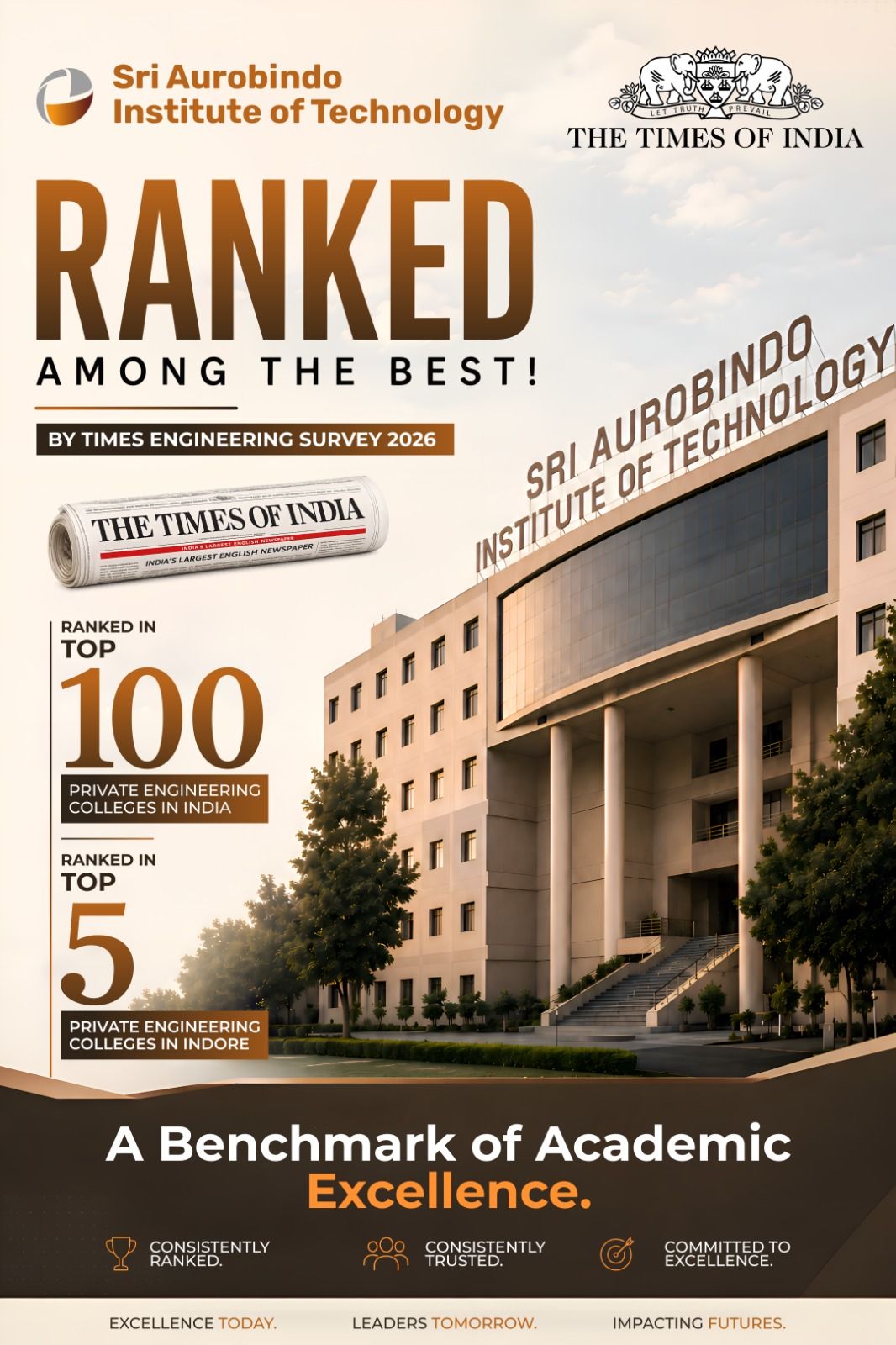
SAIT — B.Tech, M.Tech, MBA, MBA-HA. RGPV affiliated, AICTE approved. 90%+ placements.
SAIP — B.Pharm, M.Pharm, D.Pharm, Pharm D.
SAIM&S — BBA, BBA-HA, B.Com.
CDS — B.Des. RGPV affiliated, AICTE approved. Studio-based learning.
Latest News and Events